
How Does Celery Lower Blood Pressure?
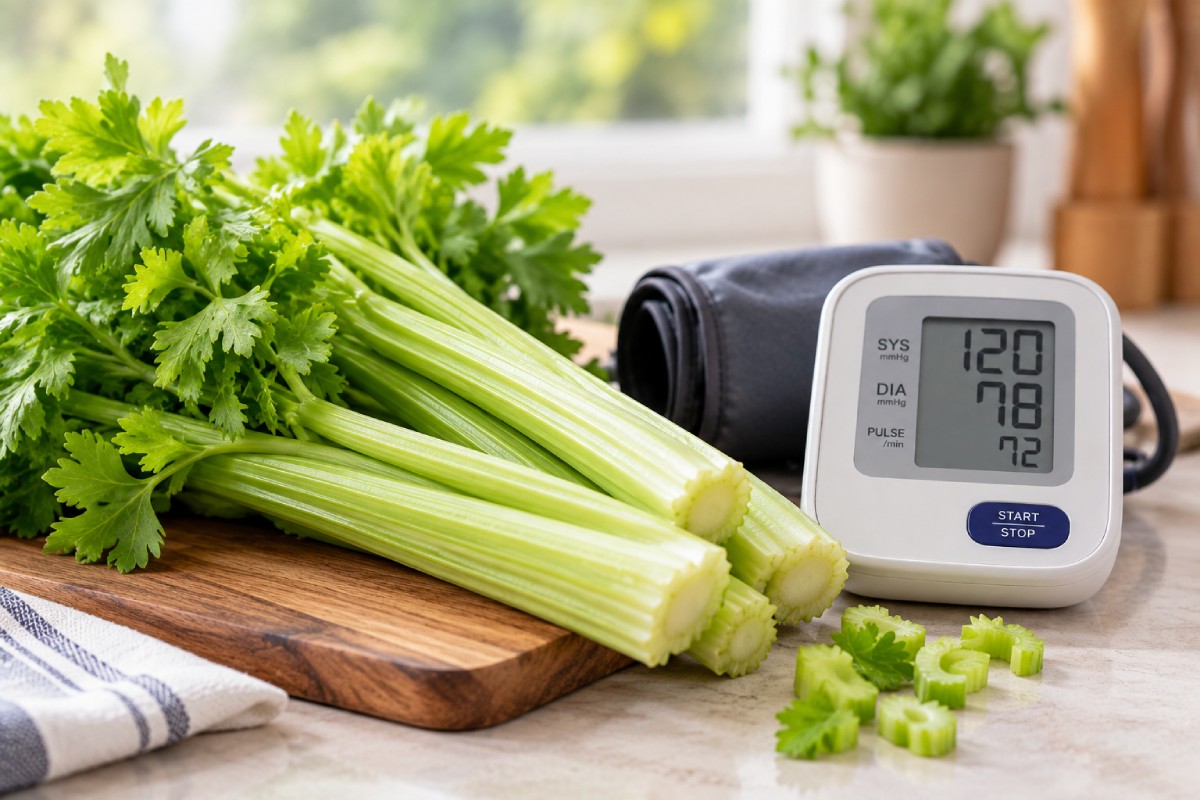
Celery may lower blood pressure modestly by relaxing artery walls, protecting the vessel lining, supplying potassium, and gently reducing fluid volume. The strongest evidence is for concentrated celery-seed extract, not for eating a few stalks, and celery should support, never replace, prescribed treatment.
The Four Ways Celery Acts on Blood Pressure
Blood pressure is the product of how hard the heart pumps, how much fluid is in circulation, and how relaxed or constricted the arteries are. Celery, and celery seed in particular, appears to nudge several of those levers at once. None of the effects is dramatic on its own, but together they explain why the plant keeps showing up in blood-pressure research. Here is what the science points to:
- It helps relax and widen the arteries. Celery seed is rich in phthalides, especially 3-n-butylphthalide (3-nB), the compound behind its distinctive smell. In laboratory and animal studies, phthalides relax the smooth muscle in artery walls and appear to blunt the movement of calcium into those muscle cells, a mechanism loosely similar to how calcium-channel-blocker medications work. Relaxed, wider arteries mean blood flows against less resistance, which lowers pressure.
- It protects and supports the vessel lining. Celery contains flavonoid antioxidants such as apigenin and luteolin, along with naturally occurring nitrates. These support the endothelium, the thin lining of the blood vessels, by helping it release nitric oxide, the signal that tells arteries to relax. They also reduce the oxidative stress and low-grade inflammation that, over years, stiffen arteries and drive pressure up.
- It adds potassium to help clear sodium. Potassium and sodium work in balance: potassium prompts the kidneys to excrete more sodium, and where sodium goes, water follows. Higher potassium intake is consistently linked with lower blood pressure. Celery stalks contribute some potassium, though they are a modest source next to beans, leafy greens, avocado, or potatoes, which is one reason celery is best seen as a team player rather than a standout.
- It acts as a gentle, natural diuretic. Compounds in celery may modestly increase the amount of sodium and water the body excretes. Lowering the volume of fluid circulating through the vessels eases the pressure inside them. The effect is mild, closer to the direction a low-dose water pill nudges things than a replacement for one.
An Important caveat on mechanism: the strongest of these effects turn up with concentrated celery-seed extract, where the active compounds are many times more concentrated than in the crunchy stalk. Eating celery is genuinely good for you, but it is the seed and its extract that carry the measurable blood-pressure signal.
What Does the Research Show?
A 2025 meta-analysis of nine randomized controlled trials in 511 adults found significant drops in both systolic and diastolic pressure, with the best results from celery seeds or
preparations above 1,000 mg per day (Liu et al., 2025).
In a 2022 crossover trial, 52 adults taking celery-seed extract (1.34 g per day) for four weeks saw daytime blood pressure fall by roughly 12/9 mmHg compared with placebo (Shayani Rad et al., 2022).
The caveats are real, and worth being honest about: the trials were small and short, the preparations varied widely, the ideal dose is not established, and no study has shown that celery prevents heart attack or stroke. Celery is a helpful addition to a blood-pressure plan, not a cure.
Stalks, Juice, or Seed Extract: Which Form Actually Works?
This is the question that trips most people up, because the form of celery matters more than the amount. The active compounds are concentrated in the seed, so the blood-pressure evidence rises steadily from the stalk you snack on to the standardized extract studied in trials. Here is how the forms compare:
| Form | Strength of Evidence | Best Use |
|---|---|---|
| Whole stalks | Low | Everyday food; swap in for salty snacks |
| Celery juice | Moderate | Optional; limited evidence |
| Ground celery seed | Moderate to high | Seasoning in place of salt |
| Standardized seed extract | Highest | Only under physician supervision |
A few practical distinctions worth understanding:
- Whole stalks are the everyday hero: high in water and fiber, very low in calories, and naturally low in sodium, which makes them an easy swap for chips and crackers. They deliver a little potassium and the plant compounds, but at concentrations too low to expect a measurable drop in your numbers.
- Celery juice concentrates more of the plant into a glass, but it strips out the fiber that makes celery filling and slows sugar absorption, and the specific evidence for juice is limited. It is fine if you enjoy it; it is not a proven blood-pressure treatment.
- Ground celery seed is a smart, low-effort win: used as a seasoning in place of salt, it adds flavor and phthalides while cutting sodium at the same time, which helps blood pressure from two directions at once.
- Standardized seed extract is the only form that produced the reductions seen in clinical trials, at doses around 1,000 mg or more per day. Because it is potent enough to interact with medication and lower pressure meaningfully, it belongs in the supervised category, not the grocery-cart one. Supplements are also not tightly regulated, so quality and actual dose vary between brands, another reason to involve a physician.
How to Use Celery in a Blood-Pressure-Friendly Diet
Celery does its best work as one part of a proven eating pattern rather than a standalone remedy. The most studied of these is the DASH eating plan (Dietary Approaches to Stop Hypertension), which in clinical trials lowered systolic blood pressure by roughly 8 to 11 mmHg, an effect comparable to some medications, especially when sodium is also reduced.
DASH emphasizes vegetables, fruits, whole grains, beans, nuts, and low-fat dairy, and limits salt, added sugar, and saturated fat. It caps sodium at 2,300 mg a day, with a lower target of 1,500 mg for a bigger effect, and leans on potassium, calcium, and magnesium from whole foods. Celery fits this pattern naturally: it is low in sodium, adds a little potassium, and replaces saltier snacks.
Simple, realistic ways to work it in:
- Swap salty snacks for celery sticks, with hummus or nut butter instead of chips and dip.
- Build soups and stews on a base of celery and onion, which adds flavor without relying on salt.
- Season with ground celery seed in place of table salt or celery salt, to cut sodium while keeping the taste.
- Round out the plate with higher-potassium foods, such as beans, leafy greens, avocado, and potatoes, which do more of the heavy lifting.
- Track your readings at home, in the morning and evening, so you and your physician can see what is actually working over weeks, not days.

Is Celery Safe?
Celery as food is safe for almost everyone. Never stop or reduce blood-pressure medication on your own. Talk with your physician before using concentrated celery-seed supplements if you take blood-pressure medicine, diuretics, or warfarin, have kidney disease, are pregnant, or have a celery allergy. Concentrated extracts can add to the effect of medication and push pressure too low, so supervision matters.
Why weMED Clinics Is So Effective at Lowering Blood Pressure Naturally

weMED Clinics lowers high blood pressure naturally by treating its root causes with four coordinated pillars: Western medicine, functional medicine, regenerative medicine, and East-West medicine with acupuncture, all under physician supervision. With 20 years of experience and three Houston centers, weMED is dual-credentialed in Western and East-West medicine. Acupuncture and Eastern medicine care is led by Dr. Bing You and Dr. Tao Ma, each with more than 30 years in integrative East-West medicine.
- Root causes, not just readings. Plans target insulin resistance, weight, stress, sleep, inflammation, and arterial stiffness.
- Four pillars in one plan. Advanced labs and personalized nutrition, acupuncture and breathwork, regenerative therapies, and safe medication management.
- Consistent follow-up. The Holistic Hypertension Club offers Basic ($399/mo), Core ($599/mo), and Premium ($999/mo) tiers, all including every pillar.
- Measurable progress. Many members see improvement within 4 to 8 weeks and, where appropriate, medication reductions within 6 to 12 months.*
Frequently Asked Questions

Talk to an integrative physician
First appointment within 48 hours. Telehealth or in person at any of our 3 Houston-area locations.
Book appointmentShare
Ready to Take the Next Step?
Request a consultation with weMED Clinics. Fill out the form and our team will get back to you shortly.
Our Locations
Three weMED clinics serving the Greater Houston area. Choose the one closest to you.
Central Location
4126 Southwest Fwy # 1130, Houston, TX 77027
(281) 784-9046Office Hours
- Mon – Thu9:00 AM – 6:00 PM
- Fri8:30 AM – 4:00 PM
- Sat9:00 AM – 1:00 PM
- SunClosed
The Woodlands
3115 College Park, Suite 106, The Woodlands, TX 77384
(832) 346-8429Office Hours
- Mon – Fri10:00 AM – 6:00 PM
- Sat9:00 AM – 6:00 PM
- SunClosed
Cypress
27200 Highway 290, Suite 200, Cypress, TX 77433
(346) 545-5775Office Hours
- Mon – Thu9:00 AM – 6:00 PM
- Fri – Sat9:00 AM – 4:00 PM
- SunClosed