
Functional Medicine for Type 2 Diabetes in Houston, TX
Find what’s driving your blood sugar, not just the numbers.

weMED Health offers a physician-supervised functional medicine program for adults in Houston living with type 2 diabetes, prediabetes, or insulin resistance. The program combines detailed lab testing, personalized nutrition, and regular follow-up to help lower A1C and, for some patients, work toward type 2 diabetes remission.
We don’t promise a cure. We build your plan around your labs, your health history, and your goals, and we coordinate with your primary care doctor or endocrinologist. Individual results vary.
- ★★★★★ 4.9 on Google (103 reviews)
- Serving Houston since 2006
Medically reviewed by Dr. Bing You, M.D. (China), L.Ac. · Updated October 9, 2026
Who Our Diabetes Program Is For
Our goal is to help you lower your A1C, improve how your body responds to insulin, and build habits that last, with a personalized, physician-supervised plan.
This program is designed for type 2 diabetes and related metabolic conditions. It is not a treatment for type 1 diabetes.
Can type 2 diabetes be reversed?
American Diabetes Association consensus report, Diabetes Care, 2021
For many people, type 2 diabetes can go into remission
In 2021, the American Diabetes Association and its international partners defined remission as an HbA1c below 6.5% that stays there for at least three months after stopping glucose-lowering medication. It is most often reported after significant weight loss combined with lasting changes to eating and activity. It isn’t guaranteed, and it doesn’t happen at the same pace for everyone.
Who is most likely to reach remission?
- A type 2 diabetes diagnosis within the last few years
- Losing a meaningful amount of weight and keeping it off
- Not yet needing insulin
- Regular follow-up with a care team
If you’ve had diabetes for longer or already use insulin, a structured plan can still help you lower your A1C and feel better day to day. Your provider will set realistic goals with you at your first visit.
How Our Diabetes Program Works
Five steps, supervised by a licensed provider who adjusts your plan as your results come in. Built on nutrition, movement, sleep, stress management, and targeted supplementation, with acupuncture and other integrative therapies available where appropriate.
Comprehensive Metabolic Lab Testing
Depending on your history, testing may include HbA1c, fasting glucose and insulin, a lipid panel, thyroid markers, kidney and liver function, vitamin D, and inflammation markers such as hs-CRP. This shows us what’s driving your blood sugar before we build your plan.
A Personalized Nutrition Plan
Using your labs, food preferences, and schedule, we create an eating plan designed to lower A1C naturally and keep your blood sugar steadier through the day, built around foods you already eat and can keep eating.
Weight, Sleep and Activity Coaching
Weight loss is one of the strongest drivers of better blood sugar control. We set realistic targets for weight, movement, sleep, and stress, add targeted supplementation when appropriate, and check in regularly. Your provider may also discuss medical weight loss options.
Medication Review With Your Physician
As your numbers improve, your provider reviews your medications with you. Any change to metformin, insulin, or other diabetes medication is made only by a physician, based on your lab results. Never stop or change a medication on your own.
Ongoing A1C Monitoring and Follow-Ups
A1C reflects your average blood sugar over about three months, so we recheck it at regular intervals and track fasting glucose between visits. Scheduled follow-ups keep your plan on track and help us spot changes early.
Why Choose weMED Health?
weMED has combined Eastern and Western medicine in one Houston practice since 2006. Functional medicine doesn’t replace your endocrinologist or primary care doctor. It adds the time, testing, and lifestyle support that a standard visit often can’t fit in.
Meet Your Houston Functional Medicine Provider

Integrative & Functional Medicine
Lead clinician for weMED’s diabetes program
Dr. Bing You founded weMED Health in 2006 to combine Eastern and Western medicine in one practice. Trained as a physician at Chengdu University of Traditional Chinese Medicine, he is a Texas-licensed acupuncturist and an NCCAOM Diplomate in both Acupuncture and Herbology. His clinical focus includes chronic conditions such as type 2 diabetes, hypertension, and digestive health.
At weMED, Dr. You works to turn each patient’s lab results into a plan that fits real life, and stays involved through every follow-up.
Real Patient Results
Outcomes from weMED’s published diabetes case studies. Results vary from person to person.
Hear it from weMED patients

Reverse the effects diabetes has on you
From years of diabetes and retinopathy to stable vision and better energy
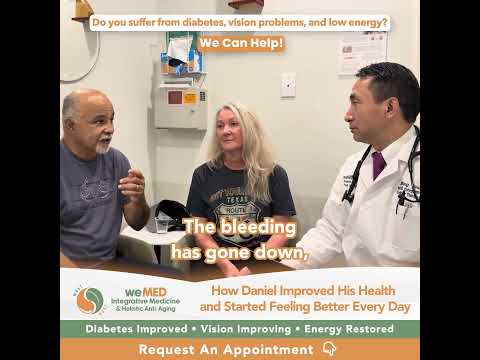
How Daniel improved his health and started feeling better every day
Case outcomes are drawn from weMED’s published diabetes case studies; more video patient testimonials are on weMED’s testimonials page. Results vary and depend on medical history, lifestyle, and adherence to the care plan.
Serving Houston, Cypress and The Woodlands
Our central location is in the Galleria area of Houston. Patients come to us for diabetes and metabolic care from across Greater Houston, including River Oaks, Bellaire, Katy, and Spring.
Central Location
4126 Southwest Fwy #1130, Houston, TX 77027
(281) 784-9046 · frontdesk@wemedclinic.com
The Woodlands
3115 College Park, Suite 106, The Woodlands, TX 77384
(832) 346-8429
Cypress
27200 Highway 290, Suite 200, Cypress, TX 77433
(346) 545-5775
Type 2 Diabetes FAQs
Is type 2 diabetes reversible?
Can type 2 diabetes be reversed permanently?
Can type 2 diabetes be reversed with diet and exercise?
How long does it take to lower my A1C?
Can I stop taking metformin?
Does insurance cover functional medicine?
What lab tests are included in the program?
Can type 1 diabetes be reversed?
Sources
- Riddle MC, et al. Consensus Report: Definition and Interpretation of Remission in Type 2 Diabetes. Diabetes Care. 2021;44(10):2438–2444.
- Lean MEJ, et al. Primary care-led weight management for remission of type 2 diabetes (DiRECT). The Lancet. 2018;391:541–551.
- CDC, National Diabetes Statistics Report.
- NIDDK, Insulin Resistance and Prediabetes.
Medically reviewed by Dr. Bing You, M.D. (China), L.Ac. · Last updated October 9, 2026
This page is for general information and isn’t medical advice. Results vary. Talk with your healthcare provider before making changes to your treatment.
Ready to take control of your blood sugar?
Your first visit is a functional medicine evaluation that begins with diagnostic lab testing to find what’s driving your blood sugar, followed by a plan built on nutrition, movement, sleep, and stress management, with clear next steps. We coordinate with your prescribing physician or endocrinologist.

